Risk Management: The Foundation of Successful Trading
Kojo Forex
Author

Most traders enter the financial markets focused on one objective: making money. They spend countless hours searching for the perfect strategy, the most accurate indicator or the best entry signal. However, long-term success in trading is rarely determined by how many trades a trader wins. It is determined by how well the trader manages risk when the market moves against them.
Risk management is the process of controlling how much money is exposed on every trade. It protects trading capital, reduces emotional pressure and allows a trader to remain in the market long enough for their strategy to produce consistent results.
A trader can have an excellent strategy and still lose an entire account through poor risk management. At the same time, a trader with a moderately profitable strategy can achieve sustainable growth by controlling losses and protecting capital.
Capital Preservation Comes First
The first objective of every trader should not be to make a profit. It should be to protect the trading account.
Trading capital is the tool that gives a trader access to future opportunities. Once the capital is lost, the trader can no longer participate in the market. This is why professional traders focus heavily on preservation before growth.
Every trading strategy will experience losing trades. No setup, signal or analysis is guaranteed to succeed. Risk management ensures that one incorrect analysis, unexpected market movement or emotional decision does not cause significant damage to the account.
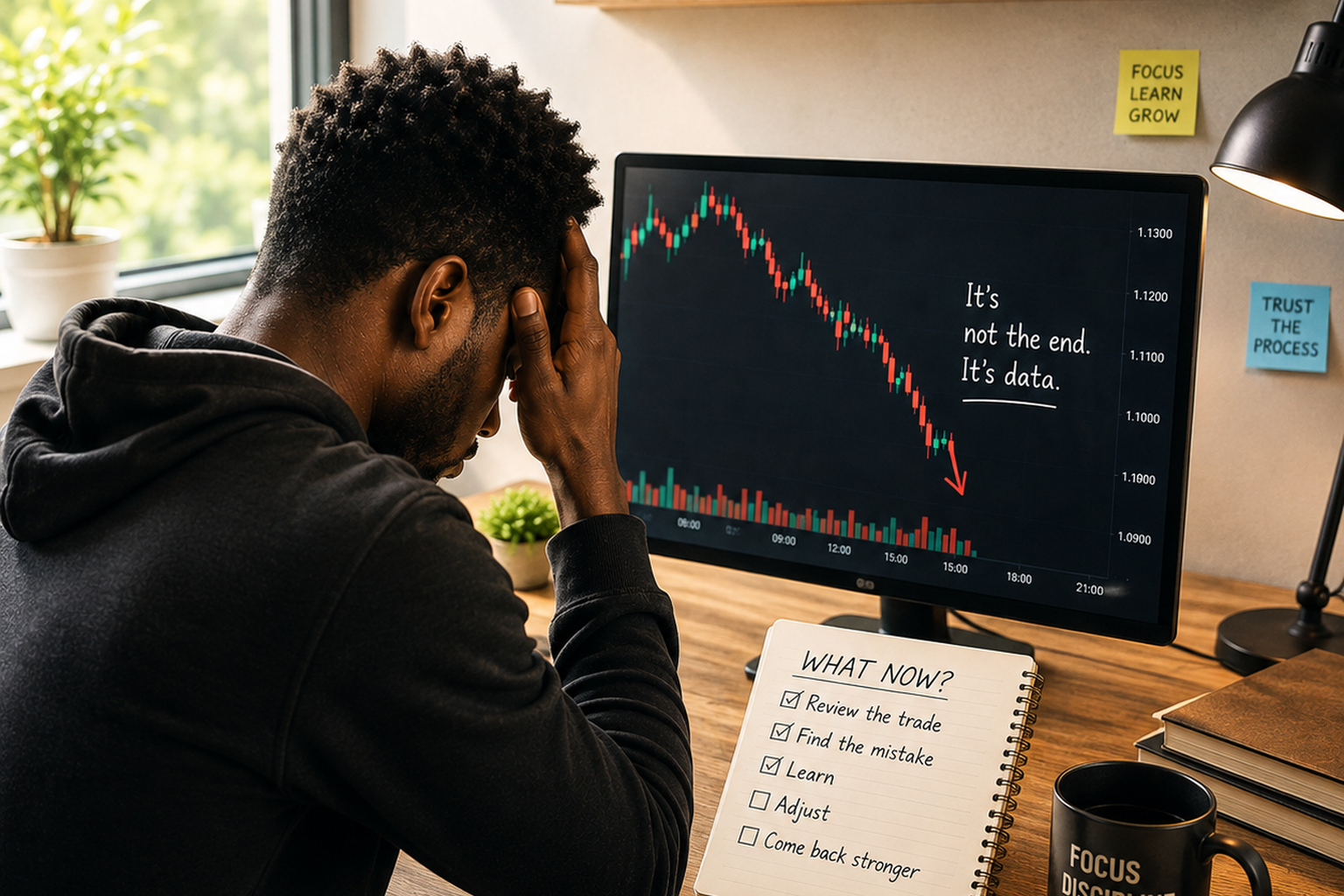
A trader who protects capital can recover from a period of losses. A trader who risks too aggressively may not have enough capital left to recover.
Risk a Small Percentage Per Trade
One of the most important principles of risk management is limiting the percentage of the account exposed on a single position.
Many disciplined traders risk between 0.5% and 2% of their account balance per trade. The appropriate percentage depends on the trader’s experience, strategy, account size and tolerance for drawdown.
For example, risking 1% on a $10,000 trading account means the maximum planned loss on one trade is $100. If the trade loses, approximately 99% of the account remains available for future opportunities.
The purpose of percentage-based risk is to keep losses proportional to the account. As the account grows, the amount risked can gradually increase. When the account decreases, the amount automatically becomes smaller, helping to slow down further losses.
A trader should never increase risk simply because they feel confident about a setup. Confidence does not remove uncertainty from the market.
Always Use a Stop Loss
A stop loss defines the point at which a trading idea becomes invalid. It prevents a manageable loss from developing into a major one.
The stop loss should be placed according to market structure rather than emotion. For a buy position, it may be placed below a relevant support level, swing low or structural invalidation point. For a sell position, it may be placed above a resistance level, swing high or invalidation area.
The distance between the entry and the stop loss should determine the position size. The trader should not use the same lot size on every trade without considering the stop-loss distance.
A wider stop loss requires a smaller position size. A tighter stop loss may allow a larger position size, provided the total monetary risk remains within the trader’s predetermined limit.
Moving a stop loss farther away because the trade is losing is usually a sign of poor discipline. It increases the original risk and allows emotions to interfere with the trading plan.
Position Size Should Be Calculated, Not Guessed
Position sizing determines the volume or lot size used on a trade. It connects the account balance, risk percentage and stop-loss distance.
Before entering a position, a trader should know:
The account balance.
The percentage being risked.
The exact monetary amount at risk.
The distance from the entry to the stop loss.
The correct position size.
For example, two traders may enter the same setup but use different lot sizes because their account balances or stop-loss distances are different.
Using a large position with a tight stop loss does not automatically mean the trade is safe. The total financial exposure must still be calculated correctly. Position size should always be based on the amount the trader is prepared to lose if the setup fails.
Understand Risk-to-Reward Ratio
Risk-to-reward ratio compares the amount a trader is willing to lose with the potential profit expected from a trade.
A 1:2 risk-to-reward ratio means the trader is risking one unit to potentially gain two units. For example, risking $100 to target a $200 profit represents a 1:2 ratio.
A favourable risk-to-reward ratio allows a trader to remain profitable without winning every trade.
Suppose a trader takes ten trades, risks $100 on each trade and targets $200:
Six losing trades would produce a total loss of $600.
Four winning trades would produce a total profit of $800.
The trader would still finish with a net profit of $200.
This demonstrates why win rate alone does not determine profitability. A trader can win fewer trades than they lose and still remain profitable when the average winning trade is larger than the average losing trade.
However, traders should not force unrealistic profit targets simply to create an attractive ratio. Take-profit levels should be based on market structure, liquidity, support and resistance, and the expected movement of price.
Avoid Overleveraging
Leverage allows traders to control positions that are larger than their deposited capital. Although leverage can increase potential returns, it also increases the speed and severity of losses.
Overleveraging is one of the main reasons traders lose accounts. A small market movement can cause substantial damage when the position size is too large.
High leverage should never be treated as permission to use excessive lot sizes. The availability of margin does not mean the trader should use all of it.
A disciplined trader considers the amount at risk, not simply the maximum position the broker permits. Leverage should be used carefully as a trading tool, not as a shortcut to rapid profits.
Control Total Market Exposure
Risk management should not only be applied to individual trades. Traders must also consider their total exposure across all open positions.
Opening three trades and risking 2% on each position creates a combined exposure of 6%. This can become even more dangerous when the trades are correlated.
For example, a trader may open positions on gold, EUR/USD and GBP/USD without realising that all three trades are heavily influenced by movements in the US dollar. Although they appear to be separate setups, they may behave like one large position.
Before opening multiple trades, the trader should calculate the total potential loss if every position reaches its stop loss. A maximum daily or combined exposure limit can prevent several losses from significantly damaging the account at the same time.
Establish a Maximum Daily Loss
A maximum daily loss protects the trader from emotional decision-making after a difficult trading session.
After two or three consecutive losses, traders may become frustrated and attempt to recover the money immediately. This often leads to revenge trading, larger position sizes, lower-quality setups and further losses.
A daily loss limit provides a clear stopping point. Once the limit is reached, the trader should stop trading and review the session.
For example, a trader may decide to stop after:
Losing 3% of the account in one day.
Experiencing three consecutive losing trades.
Breaking one of the rules in the trading plan.
Stopping after reaching the limit is not a sign of weakness. It is a professional decision designed to protect capital and mental clarity.
Manage Drawdown Carefully
Drawdown is the reduction in an account from its previous highest balance or equity level.
Recovering from a drawdown becomes increasingly difficult as the percentage loss grows. A 10% loss requires approximately an 11.1% gain to recover. A 20% loss requires a 25% gain. A 50% loss requires a 100% return just to return to the original balance.
This is why avoiding large losses is more important than attempting to generate extremely high returns.
During a drawdown, a trader should consider reducing risk rather than increasing it. Lowering the risk per trade can reduce emotional pressure and provide time to evaluate whether the losses are caused by normal strategy performance, poor market conditions or a lack of discipline.
Do Not Risk Money You Cannot Afford to Lose
Trading capital should be separate from money required for rent, food, education, medical expenses, debt repayment or other essential responsibilities.
When a trader uses money they urgently need, every price movement carries additional emotional weight. This often results in premature exits, moving stop losses, overtrading and taking unnecessary risks.
Trading should be approached with risk capital: money that can be exposed without damaging the trader’s basic financial security.
Removing financial desperation from trading decisions makes it easier to follow a strategy objectively.
Risk Management Controls Emotions
Fear and greed become more powerful when the amount at risk is too large.
When a position is properly sized, the trader is more likely to remain calm and allow the setup to develop according to the plan. When the risk is excessive, even a normal price retracement may cause panic.
Proper risk management helps traders:
Accept losses without immediately seeking revenge.
Avoid closing profitable trades too early.
Follow predetermined stop-loss and take-profit levels.
Reduce impulsive entries.
Remain consistent during winning and losing periods.
A trader who cannot comfortably accept the possible loss on a trade is probably risking too much.
Maintain Consistency
Changing risk dramatically from one trade to another can destroy the statistical advantage of a profitable strategy.
For example, a trader may risk 1% on several winning trades and then risk 10% on one trade they strongly believe will succeed. If that single trade loses, it can erase the profits from many previous positions.
Risk should remain consistent and predictable. It should not be increased because of excitement, frustration, recent profits or the belief that a setup cannot fail.
Consistency allows the trader to properly evaluate the performance of a strategy. Without consistent risk, it becomes difficult to determine whether the results came from the trading system or random changes in position size.
Keep a Trading Journal
A trading journal allows traders to monitor both strategy performance and risk behaviour.
Every recorded trade should include:
The instrument traded.
The reason for entry.
The entry price.
The stop loss.
The take-profit target.
The position size.
The amount and percentage risked.
The final result.
The trader’s emotional state.
Whether the trading rules were followed.
Reviewing this information helps identify patterns. A trader may discover that most losses occur after overtrading, during certain market sessions or when risk is increased after a winning streak.
A journal turns trading decisions into measurable information that can be reviewed and improved.
Develop a Personal Risk Management Plan
Every trader should have written risk rules before entering the market. A basic risk management plan may include:
A fixed risk percentage per trade.
A maximum number of trades per day.
A maximum daily and weekly loss.
A minimum acceptable risk-to-reward ratio.
A maximum combined exposure across open positions.
Rules for correlated trades.
Conditions for reducing risk during drawdown.
Conditions for increasing risk as the account grows.
A rule against moving stop losses farther from the entry.
A rule to stop trading after emotional or undisciplined decisions.
These rules should be decided before the trader is influenced by an active position.
Conclusion
Risk management is not designed to prevent losses completely. Losses are a normal and unavoidable part of trading. Its purpose is to ensure that losses remain small, controlled and recoverable.
A successful trader does not judge one trade in isolation. Trading performance should be evaluated over a large series of positions. The objective is to protect capital, execute a proven strategy consistently and allow probability to work over time.
The market will always provide another opportunity, but only traders who protect their capital will be available to take advantage of it.
In trading, making money is important. However, keeping enough capital to continue trading is what makes long-term profitability possible.